
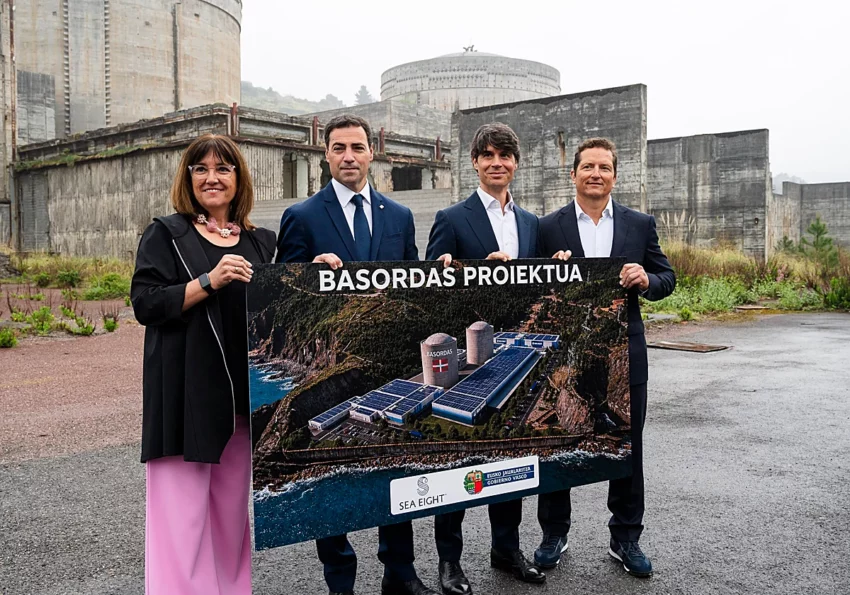
The Basque Government has presented the development of an aquaculture park at the site of the former Lemoiz nuclear power plant, originally constructed in the 20th century but never commissioned due to sustained public opposition. This initiative constitutes a strategic effort to modernize and diversify the agri-food sector through aquaculture, responding both to the growing global demand for animal protein and to the need for more sustainable production models.
The Lehendakari, Imanol Pradales, emphasized that the project has a clear international orientation, grounded in R&D&I, advanced technology, and sustainability, with a public–private investment exceeding €170 million over a ten-year period. Furthermore, it aligns with international trends in the repurposing of industrial infrastructure and with the European Ocean Pact, which promotes the development of the blue economy.
The Lemoiz site was selected following extensive technical studies due to its optimal conditions and will host the project led by Aquacría Basordas. The aquaculture park is expected to strengthen the agri-food value chain, increase fish production, and enhance supply stability, while integrating advanced technologies and fostering synergies with related sectors such as food processing, logistics, and commercialization.
From an economic perspective, the project is expected to generate approximately 200 qualified jobs in areas such as R&D, technical operations, and management. It will have an estimated production capacity of around 3,000 tonnes per year, focusing on high value-added species such as sole.
A key contributor to the initiative is the technological center AZTI, which will provide expertise in areas including recirculating aquaculture systems (RAS), nutrition, health management, and traceability. The complex will integrate the entire production cycle, from larval rearing to commercialization, incorporating technologies capable of reusing up to 97% of water resources.
The development will be implemented in three phases over a ten-year period, covering a total area of 46,600 m², and will adhere to ESG criteria and the Sustainable Development Goals. Construction is expected to begin in 2027, with initial production commencing in 2029 and market entry projected around 2031.
One of the defining features of the project is the adaptive reuse of the former Lemoiz facility, transforming a disused infrastructure into a sustainable productive asset. The refurbishment works are being carried out by Azpilur Euskadi, with initial works already underway.
Through this initiative, the Basque Government reinforces its commitment to an innovative, sustainable, and competitive agri-food model, aligned with global challenges related to food security, ecological transition, and industrial development. The transformation of this former infrastructure into a forward-looking sustainable project stands as a symbolic example of a society characterized by resilience and its capacity to overcome adversity. Currently, Euskadi ranks among Europe’s leading innovative regions and constitutes a “fertile ground” for international industrial investment, where institutional frameworks strongly support both social and economic development.

1 thought on “Euskadi is promoting the development of a strategic aquaculture cluster at the site of the former Lemoiz power plant, with the aim of strengthening the agri-food sector.”
Comments are closed.