

In this challenging and increasingly complex economic environment, where risks are constantly knocking at our door, volatility has become part of everyday life and uncertainty continues to weigh heavily, a new conceptual framework proposes rethinking what it means to work well, how to create healthy working environments, how to anticipate many of the internal challenges that hinder effective business development and, at the same time, become a more Conscious, Responsible, Efficient and Competitive Company.
Stressed employees, professional demotivation, room for improvement in quality and productivity, unresolved workplace and personal conflicts, and talent leaving the organisation in search of other opportunities… To a large extent, all of this is the result of a certain degree of managerial short-sightedness that calls for a clear Shared Purpose and a new constructive approach that places people at the heart of the company.
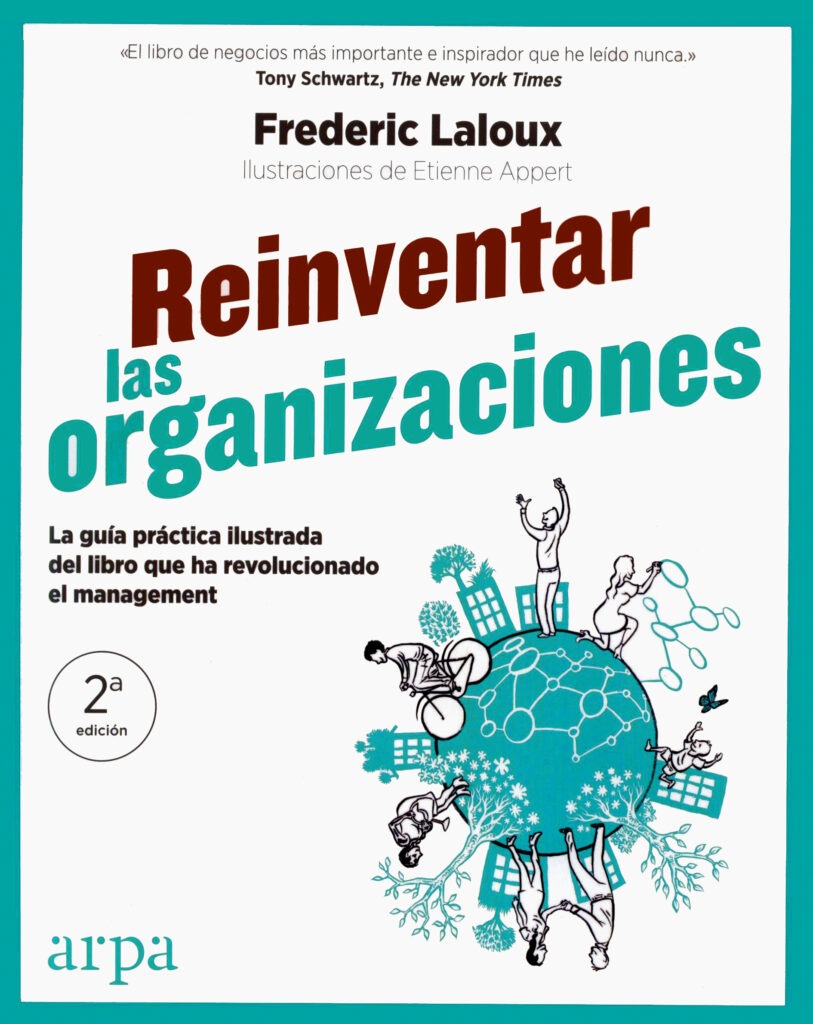
TEAL organisations, popularised by Frederic Laloux, encourage us to look beyond traditional hierarchies and explore structures that seek autonomy, fullness and continuous evolution.
In this article, we explore the origins of the TEAL concept, the “colours” Laloux used in his book Reinventing Organizations (2014) to describe the different stages of organisational development throughout history, the benefits of self-management for small businesses, as well as some concrete examples of TEAL practices in Europe, Spain and the Basque Country.
Origins and Foundations of the TEAL Concept
- The starting point
Frederic Laloux, a former McKinsey consultant and author of Reinventing Organizations (published in 2014), presents an evolutionary map of organisations: each period in history reflects a different level of consciousness, maturity and way of organising. From his perspective, today’s business structures can move beyond hierarchy and management by objectives towards a more organic and human system.
- Colour as a metaphor
Laloux uses different colours to distinguish organisational stages throughout history: Red, Amber, Orange and Green, eventually reaching the TEAL stage (turquoise, blue-green or teal). Each colour symbolises a particular mindset and set of practices, as well as different approaches to power, responsibility and decision-making which, in his view, are becoming outdated or insufficient in the face of current and future social, economic and environmental circumstances.
TEAL as a “living organisation”
The central idea is that organisations can be understood as living systems, characterised by a Shared Purpose, decentralised decision-making and a strong focus on human development. The aim is not to reduce productivity, but to align it with the values and capabilities of the people who make up the organisation.

THE COLOURS (PARADIGMS) AND THEIR CHARACTERISTICS
Red (Impulsive)
Leadership is dominated by personal authority, rewards and punishments, with an organisation based on fear and survival. Emphasis is placed on the leader’s power and on obedience. (Primitive tribes, mafia gangs, etc.)
- Structure: Informal division of labour based on the absolute power of the leader.
- Control: Submission through fear, direct punishment and displays of strength.
- Worldview: A hostile environment in which the strongest dominate in order to survive in the short term.
Amber (Conformist)
Stable hierarchical structures, rituals, clear rules and fixed roles. Rewards are usually linked to hierarchy, while institutional loyalty is valued above individual initiative. (The military, the Church, public administrations, etc.)
- Structure: Highly stable and rigid pyramid-shaped hierarchy.
- Control: Formal processes, clearly defined roles and centralised authority.
- Worldview: Conformity, strict rules and long-term stability.
Orange (Achievement)
Competitive models focused on performance and measurable results, with innovation driven by incentives and growth targets. There is greater meritocracy, although functional silos and rigid processes may still persist. (Corporations and multinational companies, banks, universities, etc.)
- Structure: Pyramid-shaped hierarchy focused on projects, specific goals and meritocracy.
- Control: Management by objectives, where “people are given freedom over how” as long as the desired results are achieved.
- Worldview: Everything can be optimised through innovation, efficiency and success.
Green (Pluralistic)
Partial decentralisation with an emphasis on values, culture and well-being. Decision-making becomes more consensual, with a stronger focus on social responsibility and talent development, although structural resistance and operational complexity may persist. (NGOs, cooperatives, companies implementing Corporate Social Responsibility and sustainability practices, etc.)
- Structure: Traditional hierarchy, but with greater empowerment at the grassroots level and more decentralised decision-making.
- Control: Values, shared culture, consensus and motivation based on a sense of belonging.
- Worldview: An organisation as a family, where human relationships, equality and social justice, or care for the planet, matter as much as or more than profits.
TEAL (fullness)
Three pillars: self-management, evolutionary purpose and fullness. Decision-making is distributed rather than centralised; people can align their work with a sense of personal and collective purpose; and the organisation is viewed as a system that evolves over time, responding to changes in its environment and to the growth of its members.
- Structure: Horizontal, transparent and dynamic, based on circles and autonomous teams.
- Control: Self-management and distributed decision-making, supported by listening processes, purpose and the common good.
- Worldview: Constant adaptability and natural evolution, like a living organism.
Advantages and Benefits of Self-Management in SMEs
- Greater agility and responsiveness to change
By eliminating excessive layers of control, small businesses with self-managing teams can respond more quickly to market changes, supplier networks and customer needs. Decision-making becomes faster when people closest to where value is created have the authority to act. - Motivation and talent retention
Self-management is often associated with a stronger sense of purpose and responsibility. Teams that participate in defining objectives and managing their own processes tend to experience greater job satisfaction and lower employee turnover. - Innovation and continuous learning
With horizontal structures, ideas can emerge from multiple levels and disciplines, encouraging experimentation and organisational learning. Mistakes are viewed as opportunities for improvement rather than as reasons for assigning blame. - Efficiency and responsible use of resources
Eliminating administrative redundancies can reduce costs and simplify processes. Decisions based on trust and data allow resources to be used more efficiently. - Cultural sustainability
Fullness as a guiding principle promotes cultures based on mutual support, inclusion and a healthy balance between personal and professional life. Organisations need to create environments where people can express themselves authentically and bring their whole selves to both their work and their lives, from Monday to Sunday and every day and moment. In the long term, this can contribute to greater organisational resilience.

Some Examples of TEAL Practices
Buurtzorg:
A home-care nursing company. It operates through more than 1,000 autonomous teams of 10 to 12 nursing professionals who are fully self-managed, without middle management, making decisions about schedules and patient care.
PURPOSE: To provide person-centred healthcare and home care, helping patients, primarily older people, recover or maintain their autonomy, dignity and independence.
- Encouraging self-care and connecting patients with their social and neighbourhood networks.
- Working without managers or traditional hierarchies, relying on the judgement and professionalism of staff.
- Integrating basic and technical care within a single, close point of reference.
Patagonia:
A technical outdoor clothing brand. It combines a culture of autonomy with a strong environmental purpose that prioritises environmental activism over rigid hierarchical structures.
PURPOSE: To operate as a business that uses its activities to protect the natural environment and promote responsible consumption.
- Durable production: High-quality clothing designed to reduce unnecessary consumption.
- Circular economy: Repair and reuse of garments through initiatives such as Worn Wear.
- Unique ownership model: 100% of the company’s voting stock was transferred to a trust and its non-voting stock to a nonprofit organisation, with profits directed towards environmental causes.
CMMB:
The Barcelona Municipal Conservatory of Music (CMMB) is a public educational institution that served as a real-world “laboratory” demonstrating how traditional public-sector structures can evolve. During his time as manager, violinist David Martí promoted a profound cultural change in team management, bringing TEAL principles into a musical and institutional environment.
PURPOSE: To provide public music education, promote professional training and foster a participatory relationship between citizens and music.
- Formal professional music education leading to qualifications for new performers.
- Open music education for adults through programmes such as Bruc Obert.
- Community connection: Bringing music, culture and musical practice closer to society in a natural and accessible way.
NER Group:
This association consists of fifteen organisations operating without traditional hierarchies in the industrial and service sectors. They share the NER (Nuevo Estilo de Relaciones, or New Style of Relationships), a model centred on people, customers, efficiency and society, and grounded in shared values.
PURPOSE: “We care for one another, learn and evolve, committed to people and society.”
- Shared benefits.
- People at the centre of decision-making.
- Transparent, open and participatory organisations.
Corporate Rebels:
Founded by Pim de Morree and Joost Minnaar, this platform seeks to transform traditional workplaces by eliminating excessive bureaucracy and rigid hierarchies in favour of self-management, autonomy and organisational vitality.
PURPOSE: “To make work more fun and humane.”
- Humanising work: Putting people at the centre rather than prioritising rigid processes.
- Fighting bureaucracy: Replacing outdated structures with agile and collaborative ways of working.
- Promoting self-management: Encouraging teams to make their own decisions and share responsibilities.
NegoBide, Círculo Empresarial Negocios y Valores:
A small socio-business organisation that brings together more than 2,500 professionals and micro-enterprises through Cooperation Meetings across the Basque Country, Navarre, La Rioja, Burgos, Cantabria, as well as Zaragoza, Madrid and Barcelona.
PURPOSE: “We help initiatives and responsible businesses with an impact to be born, grow, consolidate and expand into other regions and countries.”
- Self-employed professionals and small businesses committed to society.
- Social and environmental projects requiring professionalisation and support.
- Support throughout transformation processes involving TEAL, Sociocracy, MIPE, NER, cooperativism and other approaches.
- Support from network-based organisations such as Sannas, Humanisare and B Corp communities.
Fundación EDE:
An organisation dedicated to social transformation and socio-educational innovation that promotes human development and supports other Basque organisations in implementing TEAL organisational models and cultures.
PURPOSE: To promote human and community development, driving lasting, inclusive and sustainable change through knowledge, social intervention and inclusive employment.
- Supporting individuals, groups and Third Sector organisations.
- Promoting the common good and civic awareness in response to vulnerability.
- Working in areas such as migration, active ageing and community support.
we&uP:
A firm specialising in TEAL governance and the transformation of family-owned businesses and companies towards sustainable growth models based on purpose, culture and legacy.
PURPOSE: To apply TEAL philosophy to transform companies into more human, efficient and profitable organisations. Its approach seeks to maximise people’s potential through self-management, fullness and a shared purpose.
- Self-management: Autonomous teams without rigid hierarchies and with horizontal decision-making.
- Fullness: Enabling people to bring their whole selves to work, integrating personal well-being with performance.
- Evolutionary Purpose: Aligning the company’s vision with a deeper sense of purpose that goes beyond economic profit.
How to Start Experimenting with TEAL in an SME
- Assess Organisational Maturity
Begin by evaluating the degree of hierarchy within the organisation, the clarity of its Purpose, its capacity for organisational learning and the level of trust between teams. Identifying bottlenecks and areas where autonomy is lacking is essential.
- Define Purpose and Values
Align the entire organisation around a shared mission and a set of operating principles that guide decision-making, even when there is no single manager or leader acting as the point of reference.
- Design a Self-Management Structure
Create autonomous teams with coordinators who focus on outcomes rather than relying on rigid job titles, together with agreed mechanisms for accountability. Establish clear procedures for decision-making, conflict resolution and the redirection of projects when necessary.
- Develop fullness Practices
Promote continuous spaces for dialogue, learning, well-being and skills development. Implement practices such as open feedback, mentoring and professional development.
- Measure Progress
Define indicators that measure impact, learning and well-being, rather than focusing solely on sales or profits. Conduct regular assessments to facilitate adjustments and improvements to the operating model.
Challenges and Limitations to Consider
- Cultural Resistance
The transition towards TEAL requires a profound change in mindset and may encounter resistance from employees who are accustomed to hierarchical structures.
- Complexity in Design
There is no single way to implement TEAL. Each organisation must adapt its principles to its own context, size and sector. External facilitation and support can therefore be valuable throughout the process.
- Risk of Chaos Without Adequate Support
Self-management without a solid foundation of trust, clear processes and appropriate training can lead to uncertainty, conflict and a lack of clarity regarding responsibilities. Supporting the transition through training and external guidance is therefore essential.
- Measuring Results
In some cases, the benefits of TEAL become visible in the medium and long term through improvements in workplace culture, people-centred practices and organisational learning, as well as through economic results. It is therefore important to maintain a balanced set of appropriate metrics.
An Economic Perspective
- TEAL as a Response to Today’s Complexity
Companies seeking to combine productivity with employee satisfaction may find TEAL an attractive approach for navigating VUCA environments (Volatile, Uncertain, Complex and Ambiguous.) Management based on trust and talent development can become a sustainable competitive advantage when implemented with rigour and patience.
- Self-Management as a Driver of Growth
For SMEs, self-management is not an abstract ideology but a high-performance strategy: empowered teams, faster decision-making and a culture that facilitates continuity in the face of market changes.
- The Role of Regional Policies and Culture
In European and regional contexts such as the Basque Country, the ecosystem of cooperatives, support networks and management innovation initiatives can facilitate the adoption of TEAL frameworks. Collaboration between businesses, universities and public institutions can broaden the reach and legitimacy of these practices.
Can Your Company Become TEAL?
For many management analysts and professionals, TEAL represents a natural evolution of business activity in times of uncertainty and growing demand for Purpose. It is not about abandoning productivity, but about redesigning the way people work so that the organisation becomes as adaptable as the people who make it up.
A growing number of experiences demonstrate the positive potential of self-management. When supported by learning and a culture of trust, it can contribute to economic performance while also fostering greater fullness among employees. Although the transition is not without its challenges, the shift towards more horizontal structures is already shaping a new wave of organisational innovation.
If your business wants to explore this and other organisational models, you can connect with some of the organisations working in this field: