
The project, developed in collaboration with the Basque Culinary Center for Tokyo Tatemono, proposes an active infrastructure capable of integrating gastronomy, education, innovation, and urban revitalization in the heart of Tokyo.
Source: Mundo Empresarial Edited by Jon Erramun Arrue-Karazo
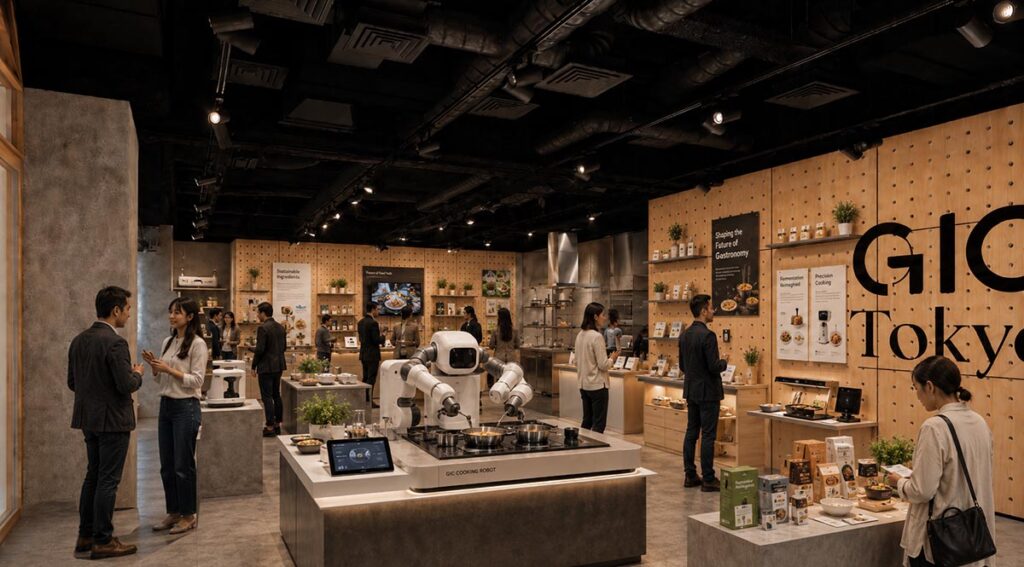
GIC Tokyo is an initiative by Tokyo Tatemono to establish a new gastronomic hub in Tokyo oriented toward a more sustainable, innovative, and regenerative future. At a time when gastronomy is consolidating as a strategic field for innovation, education, health, sustainability, and urban transformation, BAT Bilbao Architecture Team has designed in Tokyo the first international hub of GOe, the global network promoted by the Basque Culinary Center. Promoted by Tokyo Tatemono in the Yaesu area, next to Tokyo Station, the project transforms an existing 300 m² space into a flexible platform for training, culinary experimentation, food tech, events, co-creation, and openness to the city.
Contextual analysis and program definition
The project begins with an in-depth analysis of the Japanese context and the urban, social, and cultural reality of Tokyo. This research addresses the ecosystem from multiple dimensions: society, economy, and digitalization; tourism, sustainability, and innovation; gastronomy and education; and urban analysis. The objective is to understand the real dynamics of the place and lay the foundations for a comprehensive intervention that is operational and connected to its context.
Based on this reading, the Basque Culinary Center defines the program, content strategy, and activation model for the space. BAT translates this knowledge into a flexible, precise architectural solution capable of responding to a complex program within a limited area. The main challenge consists of integrating multiple uses into an existing 300 m² space, conditioned by significant physical constraints. The intervention had to ensure functional clarity, operational flexibility, and capacity for future evolution, incorporating varying degrees of public access and high technical demands.
Flexibility as a structural principle
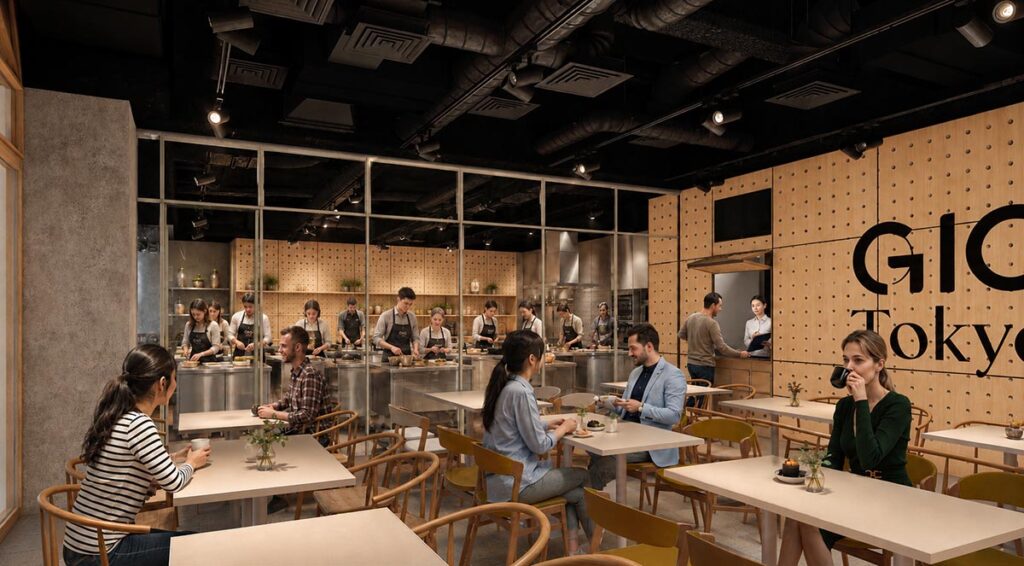
The proposal is articulated around flexibility as a structural principle. The space is conceived as an infrastructure capable of continuous transformation, where architecture ceases to act as a mere container to become an active support for changing uses. Rather than a closed and defined space, GIC Tokyo proposes an open platform for experimentation, learning, and co-creation. The architecture enables multiple scenarios: training, culinary demonstrations, dining, events, professional meetings, activities linked to gastronomic innovation, and experiences open to citizens.
This hybrid condition is reinforced through complementary spaces such as 8go Café/Bar and Tokyo Living Lab. The former functions as an open meeting point, where regeneration can be experienced through food and drink, also for those not directly participating in GIC Tokyo programs. Tokyo Living Lab, in turn, is conceived as a space to explore projects that drive regeneration and connect with like-minded people with whom to activate new collaborations in the city.
Spatial system and technical integration
The intervention is resolved through a flexible spatial system based on the combination of a fixed technical background and a series of mobile elements that allow the space to be activated in different ways. The continuous technical background concentrates the kitchen, storage, cleaning, changing rooms, and installations, freeing up the main space and reinforcing its adaptability. Modular kitchens, together with lightweight and reconfigurable furniture, make it possible to transition between multiple configurations without the need for major physical transformations.
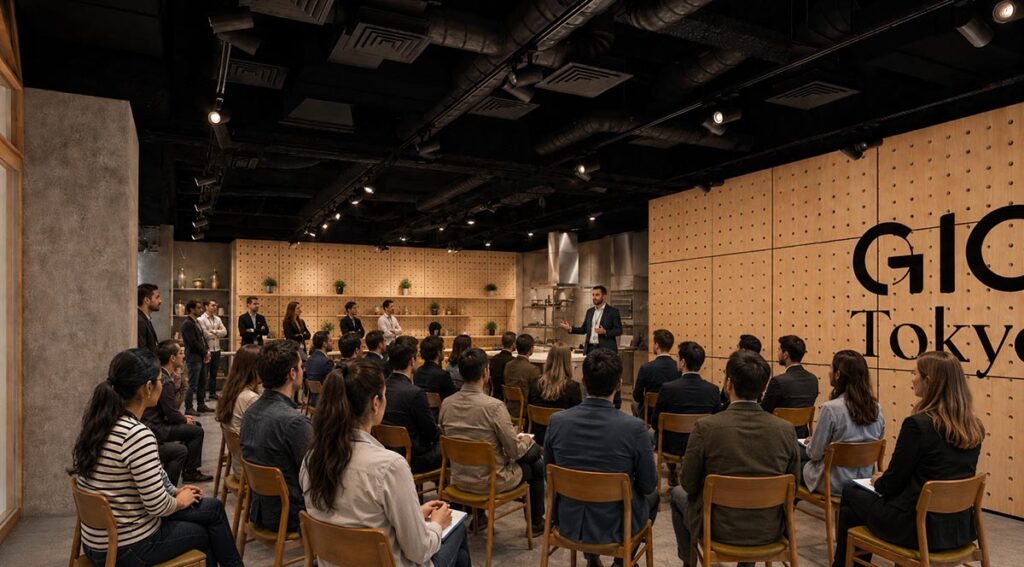
The space can function as a classroom, restaurant, gastronomic laboratory, event hall, café-bar, collaborative work environment, or urban innovation platform, always maintaining the architectural coherence of the whole. Much of the project is built from the invisible. The technical infrastructure, from the network of installations to extraction systems, adaptable lighting, audiovisual equipment, and operational support elements, is silently integrated into the architecture. This invisible layer allows the space to respond to high functional demands without compromising its clarity, flexibility, or atmosphere.
Architecture as active infrastructure for innovation and interaction
The result is a technically prepared, visually clear space capable of transforming its character according to the activity. An architecture that not only accompanies the program but enhances it, facilitating new forms of learning, encounter, creation, and participation. GIC Tokyo introduces a hybrid model that combines education, gastronomy, innovation, cultural activation, and urban regeneration. For Tokyo Tatemono, it consolidates a legacy linked to innovation and sustainability, understood from the perspective of adaptability, intensity of use, and the capacity of space to evolve over time.
A milestone in BAT Bilbao Architecture Team’s trajectory
GIC Tokyo reinforces BAT Bilbao Architecture Team’s trajectory in the design of hybrid spaces where training, gastronomy, innovation, and urban activation converge. The project adds to a line of work that understands architecture as a tool capable of promoting new models of learning, interaction, and social transformation. This vision connects with recent projects such as GOe Gastronomy Open Ecosystem, developed in collaboration with BIG Builds and the Basque Culinary Center, or the Ahantz gastronomic space in Ugao-Miraballes. All of them consolidate a common approach based on flexibility, sustainability, spatial quality, and the capacity to anticipate the needs of future spaces.
Project data
- Project: GIC Gastronomy Innovation Campus
- Architects: BAT Bilbao Architecture Team (Peru Cañada and Xabier Arranz)
- Client: Tokyo Tatemono
- Collaborators: Basque Culinary Center
- Location: Tokyo
- Built area: 300 m²
- Completion: 2024
About BAT Bilbao Architecture Team
BAT is a design firm committed since 2012 to creating innovative, future-oriented projects. Based in Bilbao and active in Madrid and London, with standout projects such as GOe (Basque Culinary Center), Hampton by Hilton Alcobendas, or the American School Brewster Madrid, BAT leads a team that combines creativity and technology to develop projects that integrate innovation, aesthetics, efficiency, and respect for the environment.
Among the services offered by BAT are Architecture, Interior Design (BAT Home Design), Strategic Consulting, and Comprehensive Project Management, in different sectors such as Culture and Education, Healthcare, Hospitality, Residential, and workspaces. In April 2026, CIC Cambridge Innovation Center and BAT formalized a strategic alliance to promote innovation spaces globally.